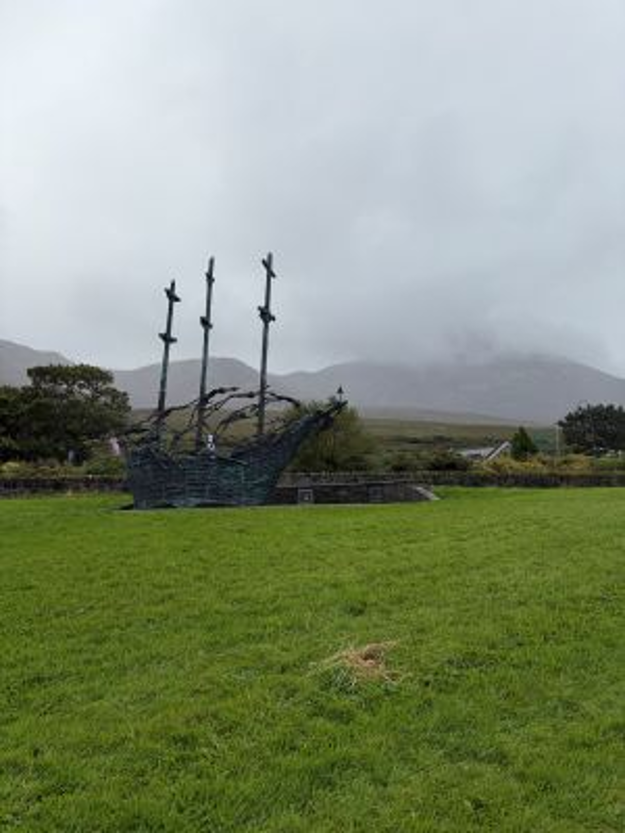
The Coffin Ship Memorial is haunting me. The hard, rugged, weather-resistant bronze, shaped like human bones… stretched… straining… like a long scream.
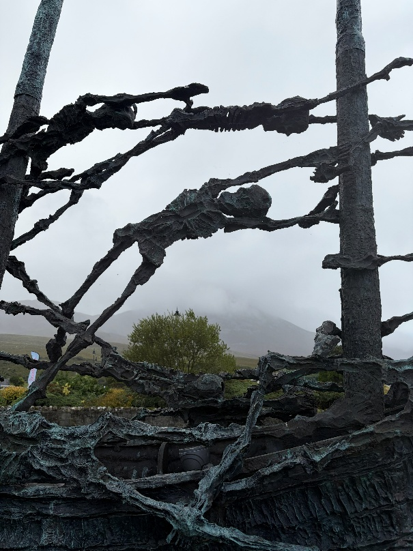
From a short distance, it looks like the three crosses on the Mount – thousands of years of irreconcilable, wrenching deaths.
An Gorta Mór, the Great Hunger, haunts the story of Gráinne as well. Perhaps, even as you have been reading these posts about a trip to Ireland in 2026, you look for traces of the Famine. And as you read the notes about the 16th Century, it might not be far from your thinking that the Famine is coming for these people. It’s hard to distinguish ourselves from our ancestors.
Before I left to come here, I had an urge to bring beach glass with me from Lake Erie for gifts to Nature, the aos sidhe[1] or wherever I felt a spiritual presence. I left one at the graves in Kilmeena of family members who stayed in Ireland and whose names echoed in the names of people I grew up with in America, including my father.[2]
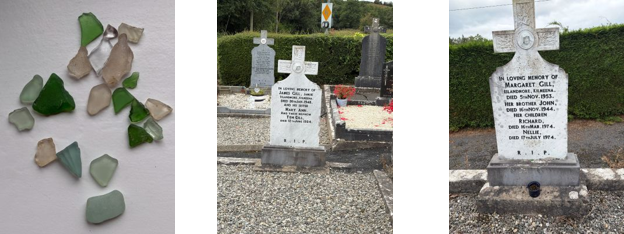
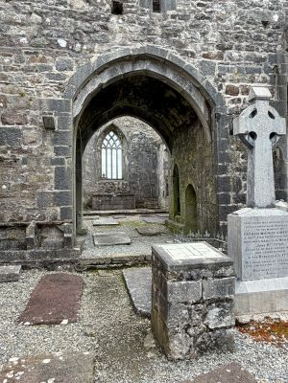
I left one on the altar in Burrishoole Abbey,[1] and another on the side of Carrickahowley Castle where I always picture Gráinne grieving her husband Richard, her tears mixing with the salt marshes there.
I left one at the Famine Memorial in Doo Lough.
And I left one at the Coffin Ships Memorial, as a sign that I had listened.
Today though, really feeling the haunting, I worked on the difference between ethnic cleansing and genocide. Briefly – as though horrific suffering is not involved – ethnic cleansing is forcing people out of a place; genocide is outright killing them.[1] Setting up the conditions for people to die lies in the space between them.
In the story I’m writing about Grace O’Malley, there is a long scream that starts before 1536 when Thomas Cromwell (distant relation to Oliver) vice-gerent in spirituals, ordered the dissolution of the monasteries – 20 in all – on the eastern side of Ireland.[2] This taking of a people’s spiritual nourishment wouldn’t reach Connacht for another 20 years or more, but over time Gráinne’s family would have kept hearing of more and more abbeys, more centers of clan communities, being desecrated and demolished, like a giant, slow, unstoppable wave coming toward them.
At that very same time, Robert Cowley, an esteemed crown official in Dublin wrote to Cromwell, recommending that the Crown burn the corn and seize the cattle “so that the Irish shall not live thereupon.”[3] Crowley went on further to advocate for the exile of the Irish from east of the Shannon. Cromwell didn’t act on this advice, but momentum was building, as was the idea of clearing the land of its inhabitants and “planting” Englishmen there. The same strategy was worked into American colonizing as well, with the added horror of capturing slaves and installing them the colonies’ Plantations.
By the time of the Second Desmond Rebellion in 1579–83, Lord Deputy of Ireland Arthur Grey de Wilton ordered “burning their corn, spoiling their harvest and driving their cattle” resulting in 30,000 famine deaths in Munster alone within just six months in 1582.[4]
In 1596, three years after Gráinne’s meeting with the Queen, Edmund Spenser, Secretary to Arthur Grey, who had witnessed the Munster famine himself actually wrote that the strategy of causing famine was working:
“there perished not manye by the sworde, but all by the extreamytie of famine,” “creepinge forth” [from the woods and glens] “upon theire handes, for theire legges could not beare them.”[5]
In 1600, a year before the Battle in Kinsale, the scorched earth strategy was used once more against The O’Neill. The takings of life, land, shelter, religion, ancient sacred places, music, language, lineage – all of it confiscated and demolished – were relentless.
Gráinne, educated as she was, would have read Lebor Gabála Érenn, The Book of the Takings (or Invasions) of Ireland. She must have sensed the inevitability of the conquest of her land. I’m in awe of how much she held off.
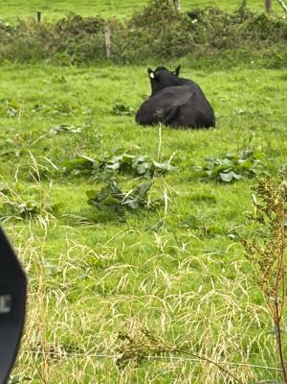
On our way to Carrickahowley, Patricia and I drove past a mighty bull. It reminds me of the epigraph of my book,
Ireland reclines like a magnificent bull settled in waving grass.
Green fields and rainbows shimmer with hope,
while wave after eternal wave of ocean,
smashing relentless, gouge the cliffs, and ever so slowly,
steal the very sod and rock
of which the country is made.
These posts build on information included in earlier posts. If you would like to read them in order from the beginning, here is a link: https://thegrainneproject.com/260809-2/
[1] https://www.britannica.com/topic/ethnic-cleansing
[2] Steven G. Ellis’s “Thomas Cromwell and Ireland, 1532–1540,”
[3] Translated by me from the Old English from R. Cowley to Cromwell, 1536 in the State Papers, Henry VIII, Vol. II, digitized and free to read: archive.org/details/statepaperspubli02grea
[4] Sir Warham St Leger was an English soldier, administrator, and politician, who sat in the Irish House of Commons in the Parliament of 1585–1586.
[5] A View of the Present State of Ireland
[1] The altar is under that stunning far window. The congregation is buried, facing east, in the derelict inner space, as well as around the outer walls. There is a lovely Irish custom of the faithful being buried facing east, yet their pastor being buried facing his flock.
[1] Pronounced shee, a supernatural race in Gaelic folklore, descended from the Tuatha Dé Danann or the gods of Irish mythology.[1] https://en.wikipedia.org/wiki/Aos_S%C3%AD
[2] I see I didn’t write this up yet. The cemetery is close to My Grandmother’s School House in 260905. I’d better get on that. I will, yeah.