The Coffin Ships Memorial is devastating.
Coffin ships is the term given to the ships that carried the starving emigrants from Ireland to America, Canada, or Australia. The desperation of people willing to get on board these ships tells me the magnitude of the dire-ness of the situation.
I’m struck by how the sculptor, John Behan, made the bronze itself look deathly. The setting feels as though Croagh Patrick itself is grieving. And if you turn your back to it, the peace of the water and rushes is relief – and I feel guilty for even noticing this in the bereft landscape.
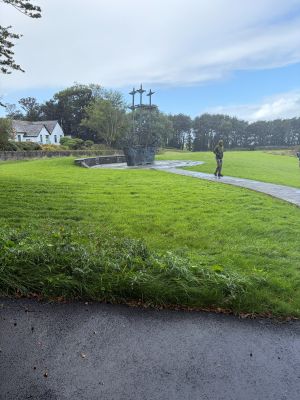
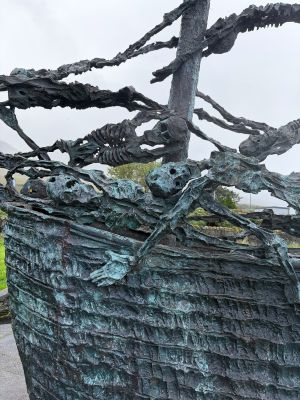
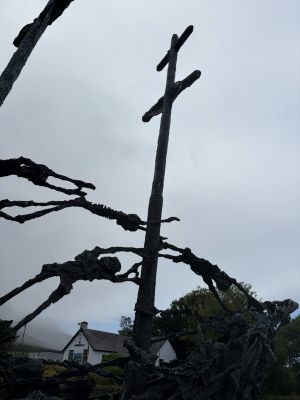
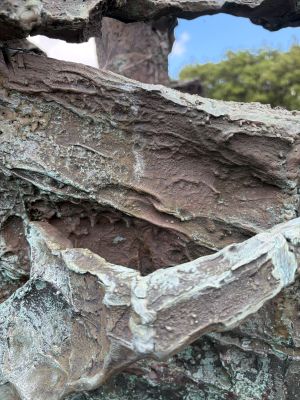
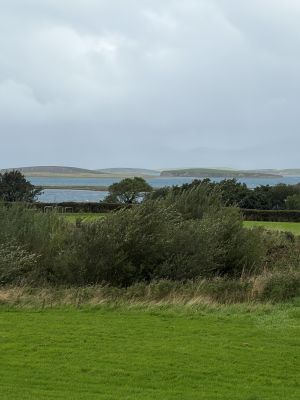
For much of my life, I thought the potato blight caused many people to die of hunger because it was their only food. I didn’t know about the disease that came along with it; and I really didn’t know about all the food that was growing there and being exported!
Throughout the darkest years of the Great Hunger, Ireland remained a net exporter of food. While the potato, the primary life-line for the peasantry lay rotting in the fields, vast quantities of high-quality grains, livestock, and dairy products were being harvested and shipped under armed guard to British and foreign markets. This devastating paradox meant that while millions faced absolute starvation, the machinery of commerce continued to move food away from those who needed it most.
From, The Irish Memorial, The Great Hunger
An Gorta Mór, the Great Hunger, arrived in 1845 and lasted into the early 1850’s. John Mitchel, one of the leaders of the Young Ireland Movement, wrote in 1860:
I have called it an artificial famine: that is to say, it was a famine which desolated a rich and fertile island that produced every year abundance and superabundance to sustain all her people and many more. The English, indeed, call the famine a “dispensation of Providence”; and ascribe it entirely to the blight on potatoes. But potatoes failed in like manner all over Europe, yet there was no famine save in Ireland. The British account of the matter, then, is first, a fraud; second, a blasphemy. The Almighty, indeed, sent the potato blight, but the English created the famine.[1]
My guide, Patricia Cox, took me to the Black Lake, Doo Lough, in County Mayo[2]. As we drove, she told me the story of the tragedy of 1849. The Great Hunger was in its fourth year. Starving people were told to come to Louisburgh (far west edge of Clew Bay where you get the ferry to Clare Island) to have it verified that they could receive assistance. Then, the hundreds of people were told that the officials had gone to Delphi[3] which was 19 kilometres, or 12 miles, south of Louisburgh. So they should go there to qualify for aid.
This is the road:




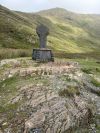
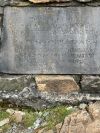
The memorial[4] is really important, but the people still had to drag themselves straggling, hungry, cold and tired, around the lake, until they reached the lodge.
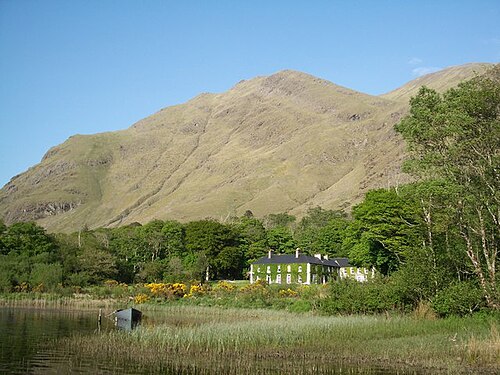
When they got to Delphi, a summer hunting lodge for Lord Sligo, they were told that the Lord and Lady were at supper and could not be disturbed and that they should return to their original location.
In the days afterwards, the bodies of women and children were found along the roadway with grass in their mouths.
I hope you will make time to read about an Gorta Mór. It will correct the history you’ve been taught, and it will help you hear the echoes that haunt Grainne’s story. And our own.
P.S. Patricia tells me that the blight is still around. When the weather conditions are right for it spreading an alert goes out for farmers to spray their fields.
[1] From Gallagher, Thomas (1987). Paddy’s Lament, Ireland 1846–1847: Prelude to Hatred. Houghton Mifflin Harcourt. ISBN 978-0-15-670700-8. Archived from the original on 14 April 2021. Retrieved 24 September 2010.
[2] The most severely affected areas were in western and southern Ireland—where the Irish language was dominant—hence, in Irish, the period was contemporaneously known as an Drochshaol,[4] which translates to “the bad life” and loosely translates to “the hard times”. Debate exists regarding nomenclature for the event, including whether to use the terms “Famine”, “Potato Famine” or “Great Hunger”.
https://en.wikipedia.org/wiki/Great_Famine_(Ireland)
[3] It’s a beautiful private house and lodge for fishing and hunting. Well, hunting is no longer allowed. But it is elegant and I can’t imagine the despair people, and shame the fathers felt as they approached its grandeur after walking that long way in cold early spring, hungry, and being told to go away. https://en.wikipedia.org/wiki/Delphi,_County_Mayo
[4] The memorial was presented by Archbishop Desmond Tutu and reads in part: “How can men feel themselves / Honoured by the humiliation / of their fellow beings” https://irishfaminememorials.com/2014/01/16/doolough-co-mayo-1994/