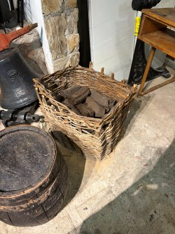
This creel basket filled with turf is in the Clew Bay Heritage Centre. A few days before I went there, Patricia and I stopped into a small pub on Achill Island in which the turf was keeping the place warm. The aroma is delightful, and smells meaty to me (though everyone I say this to looks at me like I’m an eejit).
In Ireland, deep peat layers mean a single hectare of a 2-meter-deep bog can store roughly 8,000 tons of carbon, roughly 13 times more carbon than an equivalent area of the Amazon rainforest.[1]
By 2030, new laws will go into effect, sharply reducing the cutting of turf.[2] The Country of Ireland is doing the world an enormous service. It’s humbling that this fairly small country is holding all of us so dear and doing this much to help our planet have clean air and resilient temperatures. I will say, with their ongoing efforts, the air is really clean and clear here.
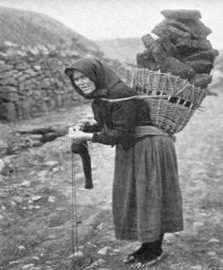
The basket at the Heritage Centre reminds me of a verse that strikes me as a good description of Grace O’Malley[1]:
It’s not sea birds or peats she’s carrying,
not fleece, nor the herring bright
but her fear that if ever she put it down
the world would go out like a light.
[1] The Creel by Kathleen Jamie
Patrick Pearse, the Irish revolutionary, reached back to Gráinne to inspire the Irish to throw off the shackles of British rule. Pearse was a poet, teacher and leader who was executed with 15 others for instigating the Easter Rising in 1916. Leading up to that event, he took up the cause of teaching the Irish Language.
Though from the opposite point of view, Pearse agreed with the English official of Gráinne’s time, Edmund Spenser, who famously said as an argument to abolish Irish, “If the tongue be Irish, the heart must needs be also.”[1]
As Pearse’s nationalist sensibilities grew, he lamented to his grandfather that “the Fenians are all dead” referring to the ancient Fianna of Irish history – young men known for their heroic deeds. He took up poetry and rewriting lyrics to inspire their rebirth in the hearts and minds of his fellow Irish, becoming an compelling orator. At the funeral of Jeremiah O’Donovan Rossa, another leader in the movement against British rule in Ireland, Pearse echoed a work Gráinne likely studied when she was learning Latin as a girl, The Tertullian Apology. Pearse’s line from that funeral oration was
Life springs from death; and from the graves of patriot men and women spring living nations.[2]
It was Pearse who rewrote the lyrics to Óró sé do bheatha abhaile (Oh, you are welcome home), a rousing chant sung by the freedom fighters during the 1916 Rising, encouraging the warriors that Grace O’Malley, a mother figure of Ireland, was on her way to help them win the battle. [3]
Tá Gráinne Mhaol ag teacht thar sáile,
Óglaigh armtha léi mar gharda,
Gaeil iad féin is ní Frainc ná Spáinnigh,
Is cuirfidh siad ruaig ar Ghallaibh.
Gráinne O’Malley is coming over the sea,
Armed warriors along with her as her guard,
They’re Irish themselves, not French nor Spanish,
And they will rout the foreigners!
Gráinne carried a lot of responsibility. She must have taken good care of her navy and seafarers, since 200 of them left their own land and followed her home to Clare Island after her first husband’s death. She kept the merchant marine service going for decades, weaving between ocean waves and warring empires, transporting imports and exports from and for the people. She took care of her half-brother Dónal into his old age. She negotiated with English governors and Irish chiefs; and managed a way around English laws and taxes with her second husband Richard, and continued after him.
She was the troop transporter from Scotland to Irish battles, and took the Gallowglasses back home again. She went right back to work as soon as she was released from prison – both times – never letting that or any other punishment stop her. She worked with the Chief of the Name who usurped her O’Flaherty son’s title to make the case to the Queen against the Lord Governor of her territory, and argued for the release of another son and her brother. Through it all, she kept her family together, like shoelaces laced back and forth across Clew Bay.
As constant as An Gorta Mór is in the psyche of those who live here, Gráinne Mhaol is a constant presence and well of strength. Her strong local memory set Anne Chambers on her quest to reveal the important role and contributions of women in history.[4] And Gráinne is still inspiring victory.[5]
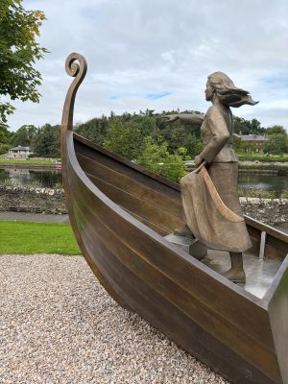
This is a bronze statue of Grace O’Malley in Newport, County Mayo, the home of the Two Graces, the other being Grace Kelly. After researching and writing the last two posts, it’s comforting to see a version of Gráinne in her glory – on her way out to sea.
These posts do build on information included in earlier posts. If you would like to read them in order from the beginning, here is a link: https://thegrainneproject.com/260809-2/
[1] It interests me that Spenser was a poet as well. Also he was quite taken with Grace O’Malley when they met.
[2] Loosely translated, the line from the Apology is, “We spring up in greater numbers the more we are mown down by you: the blood of the Christians is the seed of a new life,” but I encourage you to read the discussion of the original for it is more precise. And unstoppable.
[3] https://gaeilgeoir.ai/oro-se-do-bheatha-bhaile-meaning/ The melody is the familiar, What Shall We Do With the Drunken Sailor.
[4] https://www.redstripepress.com/living-lives-anne-chambers/
[5] The County Mayo GAA, just this year broke a 65 year curse of losing the All-Ireland championship every year. Before the teams had left the field, the crowd burst into the song that, like Óró sé do bheatha abhaile in 1916, kept them going season after season. Being a life-long Clevelander, I can tell you Cleveland Browns fans relate, and celebrate with you!
[1] https://www.independent.ie/farming/raised-bogs-can-store-13-times-the-carbon-of-amazon-rainforest/a/129737319.html
[2] There are many sources of information and argument on this topic. Here is one: https://findivo.ie/blog/turbary-rights-ireland-guide
[1] I don’t get how these footnotes work. The picture of the woman with the creel basket is from https://www.reddit.com/r/Scotland/comments/427tk3/postcard_from_1925_iseabail_sheorais_from_lewis/