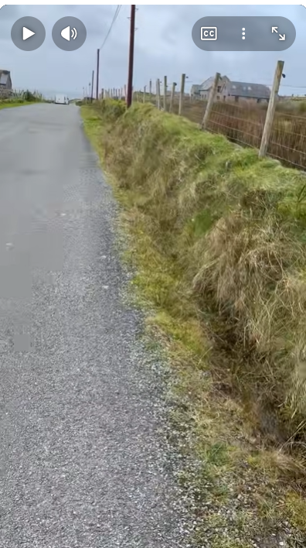
Unfortunately, my most prominent memory of Clare Island is going to be the walk up the hill to the Abbey. It’s supposed to take half an hour. It took me 40 minutes.
The mountains in and around Clew Bay are not like mountains in the U.S. There are no trees that I’m used to. And there are no foothills. If I landed here, setting up a homestead would not be my first thought.
The furrows in this scene are beds for potatoes, sometimes called Lazy Beds. However, so far I have not found a source for this term, at least not until the 18th century, and that makes me worried about a mean judgment being embedded in the term. So let’s call them furrows.
I really messed up the footage of the climb. I paused the video so that I could make fewer of them that are a bit longer to show more of a story, but instead the camera came back on, so the video is upside down and often of the gravelly road. I’ll try to come back to this post after I get time to splice together some bits that do work.
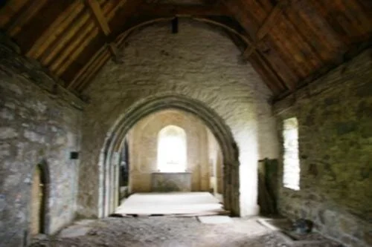
In the meantime, the Abbey is grace-filled and much more intimate than I expected. In this photo from Clare Island.ie, you can see the scale pretty well. I’m going to guess that the width of the sacristy is about 15 feet. The O’Malley crypt and emblem are on the left wall in the sacristy, near the altar. The link to this photo takes you to a site that has photos of the frescoes on the walls and ceilings.
The day I was there it was bright outside, but pretty dim inside, even though they have now installed unintrusive lighting. The crypt itself is about 6 feet wide at the most. Or the slabs on the floor in front of it are the actual crypt, like Tibbott na Long’s tomb in the floor of Ballintubber Abbey.
It was really disappointing that there are about a hundred signs prohibiting any and all photography inside. There is an excellent display of the images and the work they are doing repairing and restoring the building. But terribly disappointing for sharing.
Another website with amazing images is here: https://heritageireland.ie/unguided-sites/clare-island-cistercian-abbey/. In this photo you can see the old walls that are behind the scaffolding in my videos. https://youtu.be/RYhkF-5h69A
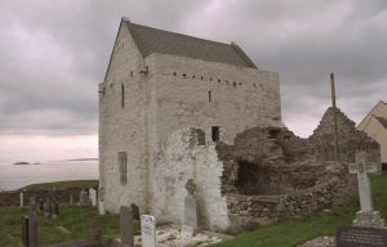
But I loved it! There were chairs set up for a presentation and I borrowed one to sit by the altar and O’Malley crypt for awhile. It’s peaceful. And the family exuded power by having their – and no other – family in the sanctuary with the altar. Gráinne couldn’t help but feel the weight of honor and duty there.
A lot of skill and strength went into the stone work. Maybe the stone is softer than I realize, but it’s still intricate and precise. From one side to the other the depth of the curves doesn’t change. I did not leave any sea glass there. With all the work on going, I didn’t think it would stay hardly at all.
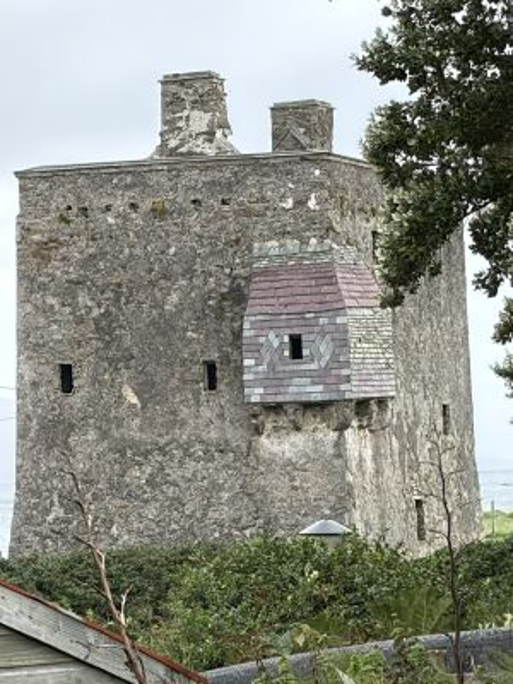
The O’Malley Castle on Clare Island is bigger than the other tower keeps we’ve seen around Clew Bay. This one stands out, imposing, even today. You’ll notice there were two chimneys and more windows. There’s just more room.
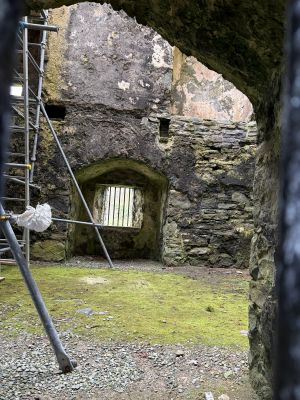
Like so many other historical sites, this castle is under repair and not accessible right now. So I stuck my phone through the window to see what I could capture. There was a good amount of room in this space. I can imagine the family liked to gather here with their Clan because it is spacious. But if they weren’t accustomed to this much spaciousness, would they have preferred Belclare or somewhere else? Once she got into it, Gráinne preferred Carrickahowley on the other, almost diagonal, corner of Clew Bay.
And the location is just more defensible. Here’s a video of the area just behind the castle:
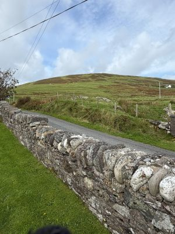
The way back down was uphill, too, at first.
Looking uphill from the Abbey on Clare Island, shows some of the terrain. In Gráinne’s story, every time you turn around, someone’s cattle is being raided. No square inch is left unproductive, so I think it’s possible that many cattle were supported. There are at least that many sheep.
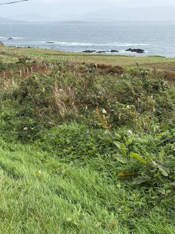
Nature built rocky walls to guard this island. You’d really have to know where you are to not wreck against them.
It was really good to meet Raphaelle who manages the Clare Island Heritage Centre. I’d like to talk with her again when I come back. They had small clay pipes, píopa, in their cases, such as the kind Gráinne’s brother liked. I also had a delightful “mini” Irish breakfast, which I couldn’t finish. Delicious, but huge. Good thing, too, because it fueled my hike up the mountain.
The ferry ride over is fun and pretty short. I’m glad I got to go. This location is so important to Gráinne’s story. It’s from where she really launches her career.