Patricia’s Sayings

- When Croagh Patrick is hazy and in the distance that means it will be good weather.
- When it’s close and clearly visible, enjoy the most beautiful calm weather!
- When it’s all dark and purple and close that means get ready to take cover
- When you see a stand of dark yew trees, it’s around a cemetery.
- A gentleman’s agreement is when you spit on your hand to make a deal and you would not go back on it. That’s in terms of animal affairs, selling and buying.
- Close the gate for him. If you open a gate, close it.
- The higher up the mountain the sheep go, the better the weather will be.
- You can tell which are the Dexter cows. They are smaller and have round rumps – and very good meat.
- In a cemetery, anyone who has drowned at sea is commemorated with a low iron railing around a grave site for them.
- The bog is like a sponge. If you should come upon the kind you feel like you’ll sink in, the thing to do is lie flat on it and you won’t sink.
- The blacker the sod of turf is, the longer it will burn. Once the gray skin forms on it, it’s fine; it won’t get wet inside it.
- Where there are moss and ferns, there’s good air.
- All you need for a town is a church, a school, and a GAA pitch.
- There are surnames of the islands in Clew Bay, the surname of the family who lives there in addition to the island’s name.
- Island people stick with island people.
Patricia, like Gráinne, was born in Murrisk. Now living in Westport, she’ll tell you she’s a bit of a snob about it. I have not heard her be an unkind snob; she just loves where she lives down into the crevices.
I notice how Grace O’Malley’s reputation covers everything around Clew Bay like an airy, crocheted shawl – names of whiskey, stores, hotels and new developments. Any place that figures in her story has a plaque about its role in her life and legend. Everyone I meet from here tells me where they grew up in relation to which of her castles. Bartenders make sure I’m taking in all of Grace’s sites. She represents pride, protection, faithfulness, and the brave fight against the English Crown oppressors.
The ongoing resistance to the Crown forces seems to flow from her like a fountain in the Bay that kept on flowing as long as it was needed. That resistance seems to follow the example Gráinne set – backing up her offers with strength (large numbers of loyal troops and allies), reaching agreements with friends and foes alike, treating people well enough that they remain loyal to her and her family, banding together with allies that could be trusted, using her education, wits and facility with language to unite (and get her way).
To a person, everyone here is grateful to Anne Chambers, Gráinne’s main biographer. Anne’s long persistence and attention to high scholarly standards is universally admired and welcome.
I’m trying to live up to Anne’s standards as well as Gráinne’s storied knowledge and wisdom. When Noreen told me the stories of resistance from Clew Bay islands that she heard the old people talk about, I realized those were stories I could use to “show-don’t-tell” how Grace and her people held off the English. The tides and shipping channels worked the same.
“Show don’t tell” is a dictum of writing advice. It means give the reader an experience without explaining, some meat to chew on to lead to their own digestion, as it were. For example, I could say, “Patricia knows all about the weather and land here around Clew Bay.” You may or may not believe me. But if I give you a list of her sayings, then I’ve shown you she knows.
When Noreen’s stories gave me the idea that I could use them to show how Gráinne and her troops managed in Clew Bay, I realized Patricia’s sayings could also be used to help a reader – and me as well – to visualize what was happening in the story or at the time.
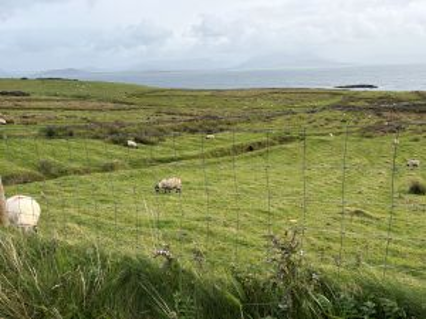
For me to write a true story. I can’t write about little Gráinne and her brother blithely walking back down a hill from school when a) the hill goes up, and b) it would have been a track through a rocky pasture.
The rules of Historical Fiction are that you cannot contradict a known fact, but you can make up a story that connects known facts as long as it really could have happened. Way back before Gráinne was born, her family were noticed for their sailing ability and peaceable nature:
A good man never was there
Of the O’Malleys but a mariner,
The prophets of the weather are ye,
A hospitable and brotherly clan.
O’DUGAN (d.1372)[1]
Gráinne must have noticed things like sheep higher on the mountain when the weather was fair, and who was living on which island. Wouldn’t you really get the feeling of her extensive knowledge if you heard Patricia’s Sayings coming out in Grace O’Malley’s speech?
[1] Quoted in Anne Chambers, Grace O’Malley: The Biography of Ireland’s Pirate Queen (1530 – 1603), page 15