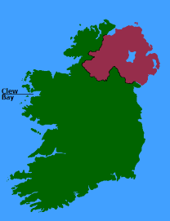
As you can see from this map, Ireland looks like a teddy bear.2 Clew Bay, where I’m staying and where most of Grace O’Malley’s story takes place, is in the bear’s paws.
It is said there are 365 islands in Clew Bay, one for every day of the year. My grandparents grew up on a couple of them – my grandfather on Island More, and my grandmother on Inishgowla. (I think there are two Inishgowlas. Her’s is south of Island More.) I’ll be staying in Westport, on the southeast shore of the Bay.
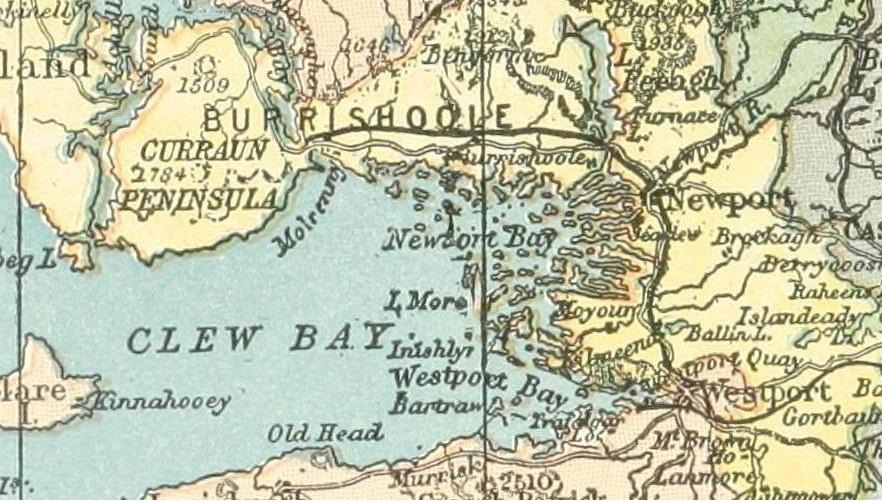
On the 1890s map below,3 you can see Island More, and many places significant to Grace O’Malley’s life. On the southern shore – you can barely see it – is Murrisk, where we’ll begin.
I aspire to tell the story of Grace O’Malley as Literary Historical Fiction.4 I found an amazing tour guide in Westport, the primary location for on-site research for my historical novel. Tricia Cox provides private tours customized to your interests. I love her website, Live Love Ireland. The picture at the top of her landing page is of Clew Bay from Croagh Patrick, the holy mountain that dominates the landscape, and where I am staying. I knew I found a kindred spirit when I saw her photo in front of an indie bookstore!
We talked on the phone about Tricia’s interests and mine and how they dovetail. She is so proud of her land, history, flora and fauna and the ancient lore that goes with them. My assignment is to give her a list of 10 places I want to visit:
Beginning at the beginning of Gráinne’s life,
- Murrisk, on the southern shore of the Bay – the castle/keep and abbey and surroundings. Was Gráinne really born here? Is there a sacred well? How does the layout of the estate, or whatever it was called, relate to the Bay itself and the river? Where did the other people live and work? What kinds of herbs were used for birthing mothers? What stands out to you, Tricia?
- Belclare Castle, gone now, was, I think, the summer home of the O’Malleys. I read something about moving the cattle inland and summer partying, called “booleying.” I’d love to learn more about this, and why move inland? Wouldn’t it be prime sailing and market season? Unless the midges were too much?
- Cathair na Mart. Westport House was built on the ruined foundations of “the fort of the beeves [cattle].” My grandfather worked at Westport House for Lord Sligo as his motorman (boat and car) in the early 20th Century. I remember my grandfather lamenting how much he missed the beef from Ireland, so I’m curious about the cattle that were here. Was there a market, or center of activity here? Can we have steak for lunch or dinner?
- Burrishoole and the friary. I’m unclear about the history of this area. I think, at the time of our story, this area was Burke family land (Richard in Iron Burke was Gráinne’s second husband, and in my view, the love of her life.) Burrishoole became an active English garrison a few km from Rockfleet — Malby took it by force in Feb 1580, and Richard-in-Iron submitted there that same campaign. I think Bingham later used it as a garrison too, after Richard’s death, but I haven’t nailed down a source for that part yet — a question for the Heritage Centre. I also think Richard’s daughter, Honora, became a nun and established a convent near there. If my memory is correct, Richard in Iron sometimes took refuge at that convent from battles he’d lost. Don’t quote me yet; the whole point of literary historical novels is to get this stuff straight. That’s why I need Patricia and the others I’m meeting with.
- Continuing around the Bay, Rockfleet / Carraigahowley was built by Richard in Iron while Gráinne was living with her first husband in County Galway. After Gráinne was widowed, she returned to Clare Island, and not too much later, married Richard and moved into Rockfleet. There are salt marshes around that tower and in my story, when Richard dies, Gráinne’s tears mix with the saltwater there. I want to sit here for awhile. This is also the place of Gráinne’s death. A couple of things I’d like to know: Could she see Croagh Patrick from there? Could she see Clare Island? Where did she keep a thousand head of cattle and horses?!
- Kildavnet Castle on the north shore was home base for Gráinne’s daughter and son in law, Richard, the Devil’s Hook, Burke. I think this tower overlooks his territory. One version is that Grace O’Malley owned this keep and made the Devil’s Hook the ward of it. I’m curious about how close these two estates are and about the joint protecting they might have enjoyed from English attacks. I’m still having a hard time believing that an English ship got into the Bay as far as Rockfleet, especially since the English could not sail into Clew Bay even in the first quarter of the 20th Century without a skilled pilot.
- Ballintubber Castle and Abbey. I have such a pull to this place, you can’t imagine. Like so much of this story, I’m pulled and get emotional for no reason I know. I am becoming more and more convinced that there is something to this Muse idea that so many artists and authors talk about. Anyway, let’s go see it.
- Michael Davitt Museum and the Land League. I’m finding a lot of Long Echoes from the 16th Century to the 20th and even 21st Centuries in what I’m learning. In January 1879, Connaught Telegraph editor James Daly began organizing what would become the Irishtown meeting that April — a peaceful gathering of thousands demanding fair rents and an end to evictions. It worked: landlords withdrew eviction notices and cut rents by up to 25%. As the Michael Davitt Museum puts it, the meeting’s success “marked a turning point in Irish social history.” (Read more on the Michael Davitt Museum site.)
- I’d like to get oriented in the landscape. I have the impression that Clew Bay is surrounded by beaches with mountains ringing around. It seems that there are rivers near all of the castles. Makes sense – no digging wells. But they’d still have to carry water to drink it, no? What else makes these places perfect for castles?
- Of course, Clare Island with its magnificent Abbey and Tower, stunning cliffs and views, and Gráinne’s tomb. I would guess I’d want to come twice – once to take in all I can and again to see what pulls me in again or to get questions answered. There’s a Heritage Center there and I’ve seen a man named Peter Gill from Island More connected to it. I’d like to meet him. I’m wondering if different guides would bring different ideas and insights to this very important location in my book?
- I’d like to visit a bog for a bit, maybe squish in it, if that’s safe.
- I want to really listen to the old language – its rhythm and breath. As I learn bits about the words I learn about the mindset/worldview of the Irish, so different from the Crown’s. It must have been confusing at first.
I want to hear the water. I want to smell the air and the turf burning. I want to hear, or at least learn about harps and bards, fabric and flowers, places in the landscape that pull you to them, or I suppose that push you away too. Where do people sense that there may be something to the old tales?
2 https://commons.wikimedia.org/wiki/File:Galway-Bay.PNG Permission is granted to copy, distribute and/or modify this document under the terms of the GNU Free Documentation License, Version 1.2

3 English: map of Clew Bay, Western Ireland around 1890. This media file is in the public domain in the United States. This applies to U.S. works where the copyright has expired, often because its first publication occurred prior to January 1, 1931. This image might not be in the public domain outside of the United States.
4 My goal, and “The goal of literary historical fiction is not to show readers exactly what life was like in a historical time period, although it may have that effect. Rather, authors who write literary historicals center their tales not on the historical setting but on the plot, which may help us better understand the differences (or parallels) between then and now, and on characters who manage to transcend time and speak to us from their own perspective in a way that we, today, can understand.” http://historicalnovelsociety.org/defining-the-genre-what-are-the-rules-for-historical-fiction/