If we think of Grace O’Malley, Gráinne,5 as a sea merchant, then we need to think about how her family managed their business, specifically when it came to money.
By the early 1300s, English control of port cities was well over a century old and thoroughly established with stone walls, market charters, and an emerging merchant class. This was really a network of fortified towns and their immediate hinterlands, not control of the island as a whole. Outside the walls, Irish lords continued to rule as they always had.
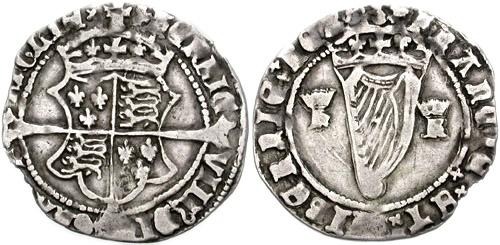
By In the 1500s, England was trying to find ways to finance its expansion and one measure to help was to prohibit exporting sterling coins out of the country. The penalty was severe – forfeiture and imprisonment.
In early 1536,6 Henry VIII started producing large coins called groats7 with Irish harps on them, meant for use in Ireland. The coins were minted with lower sterling content than coins that were struck for use in England. The new coins had to be used by everyone living in Ireland, including Crown officials and military.
As the century wore on through Elizabeth I’s reign, the coins continued to be debased even further. While at first the purpose was to reduce the cost of minting, eventually the strategy was just as much to make it difficult for the Irish to buy weapons on the continent. Yet it made trade and commerce difficult for everyone in Ireland.
The O’Malleys had what many others didn’t have: their own fleet — by some accounts as many as 20 galleys at Gráinne’s height (a number I’m still tracking down a solid source for), plus a hereditary “command of the fleet” recorded in the Book of Rights from the ancient Irish High Kings.8 This let the O’Malleys sidestep the coin problem in a couple of ways:
- When the O’Malleys received the tolls from ships in their waters, the tribute was paid and received entirely in kind — cows, hogs, and maybe beer or meade out; ships, horses, swords, and corselets in.
- The Spain trade was direct barter: iron, weapons, and wine coming in to Clew Bay, for salted fish, pine marten skins, fleeces, hides, and tallow going out. Goods for goods, no currency involved, worked out in long-established trading relationships from generations back.
5 Pronounced Graw-nye, this is her real name, not the Anglicized Grace that came afterwards.
6 Our Gráinne was six years old.
7 Worth four pennies. https://en.wikipedia.org/wiki/Fourpence_(British_coin)
8 Lebor na Cert, or the Book of Rights, is a book of Early Irish laws, from medieval Ireland. The text details the rents and taxes paid by the King of Cashel, to various others in Ireland. https://en.wikipedia.org/wiki/Lebor_na_Cert